
What is the Cimbalom?
The cimbalom (also spelled cymbalom or tsymbaly) is a type of hammered dulcimer — a stringed instrument played by striking metal strings with small wooden mallets. Known for its shimmering, percussive tone, it is the national instrument of Hungary and a centerpiece of Central and Eastern European folk music.
The cimbalom is part of a global family of hammered zithers, including the hammered dulcimer in Western Europe and North America. Other hammered zithers include the santur of Persia/Iran, the yangqin of China, the tsymbaly of Ukraine, and the hackbrett of Germany & Austria.
Though each version has its own style and tuning, all share the same principle: strings are struck by small mallets or hammers to produce rich, resonant sound. Its tone can shift from delicate and harp-like to powerful and percussive.
See the cimbalom in action below in the London Philharmonic Orchestra.
Ancient Origins of the Cimbalom
The cimbalom’s family tree stretches back over 2,000 years. It descends from early hammered zithers like the santur of Persia and the yangqin of China. Through trade and cultural exchange, these instruments spread westward into Europe.
By the 15th century, dulcimer-style instruments appeared across the continent under various names. These include the Hackbrett in Germany, the Cymbał in Poland, and the Dulcimer in England. Each version adapted to local styles and materials, laying the foundation for the modern cimbalom.
The Hungarian Cimbalom Revolution
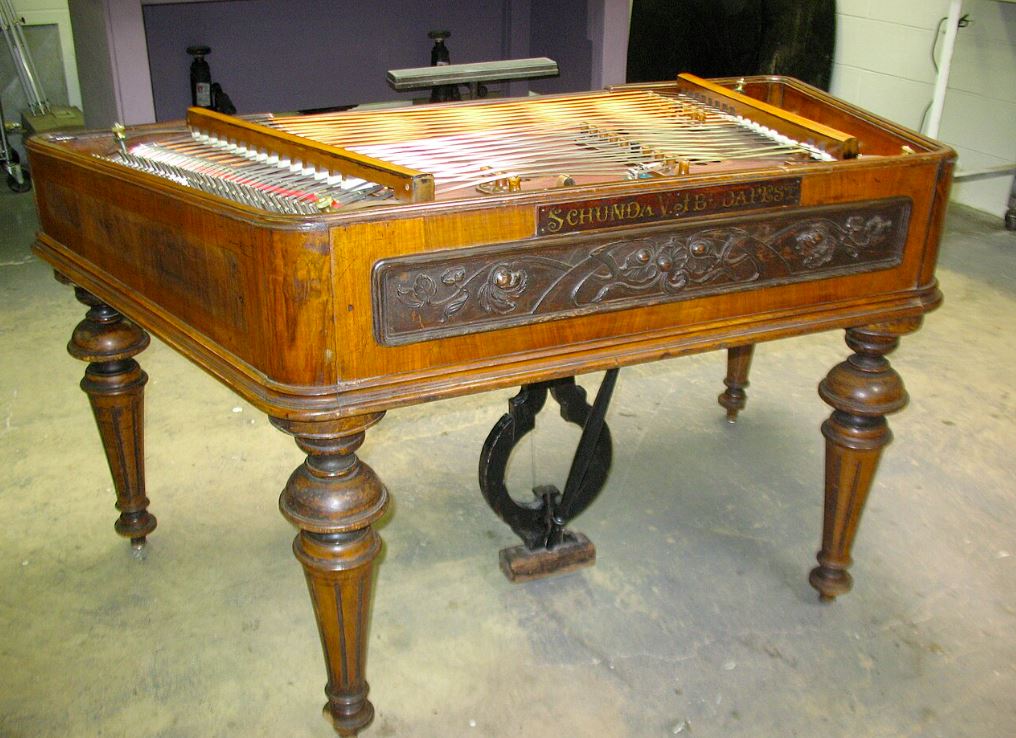
The modern concert cimbalom was born in Budapest in the 1870s, thanks to Hungarian instrument maker József Schunda. Schunda’s design innovations transformed the folk dulcimer into a concert-ready instrument.
His primary upgrades included:
- A larger frame for a wider pitch range
- Metal legs for stability
- Pedal-operated dampers for dynamic control
- Chromatic tuning, allowing it to blend in orchestras
Schunda’s model spread rapidly, becoming central to Hungarian folk and Romani (Gypsy) music and earning a permanent place in European concert halls. In fact, many virtuosos come from Hungary and Romania, where cimbalom education and performance remain strong traditions.
The Cimbalom in Folk, Classical, and Film Music
In Central and Eastern Europe, the cimbalom remains a beloved folk instrument, often heard in Hungarian, Romanian, Slovak, and Ukrainian ensembles. It accompanies traditional dances like the czardas and hora, adding energy and sparkle to the rhythm.
The cimbalom also caught the attention of great classical composers, including Franz Liszt, Béla Bartók, Zoltán Kodály, and Igor Stravinsky. Kodály’s Háry János Suite (1926) famously features the cimbalom, showcasing its bright, expressive voice.
Film and Modern Music
You can also hear the cimbalom in modern movie soundtracks, where it evokes a distinctly Eastern European atmosphere. Some interesting examples include:
- Inception (Hans Zimmer)
- The Lord of the Rings: The Two Towers (Howard Shore)
- The Grand Budapest Hotel (Alexandre Desplat)
How Does the Cimbalom Compare with the Hammered Dulcimer?
The cimbalom resembles the hammered dulcimer in many ways. With both instruments, strings are anchored to a box that is parallel to the ground, and players uses small mallets to strike the strings. As part of a global family of hammered zithers, the cimbalom offers a bright, resonant tone similar that is similar to that of the hammered dulcimer.
That said, there are a handful of key differences worth noting.
Size and Build
Traditional hammered dulcimers are relatively lightweight, and rest on simple stands or laps. The concert cimbalom is a large trapezoidal box with four legs and a heavy cast-iron frame, much like the inside of a grand piano.
Damper Pedal
A cimbalom has a foot pedal underneath. This pedal lifts dampers so the player can stop the strings from ringing instantly. Standard hammered dulcimers do not have pedals, meaning every note rings freely until it fades.
Note Range
Standard hammered dulcimers are often diatonic or have limited chromatic notes. The concert cimbalom, however, is fully chromatic and covers a massive range of over four octaves.
String Count
A typical modern hammered dulcimer has about 70 to 90 individual metal strings, arranged in pairs or courses for a total of roughly 35 to 45 courses. A concert cimbalom typically features 125–130 metal strings.
Weight
A concert cimbalom can be quite heavy, tipping the scales at over 330 pounds (approximately 150 kg). A typical mid-sized hammered dulcimer, however, weighs between 12 and 18 pounds (5.5 to 8 kg), depending on its size, wood type, and added features. Large/extended range models (chromatic or 4+ octaves) can weigh 20 pounds or more.
Standardization
As mentioned earlier in this post, the modern concert cimbalom was specifically designed and patented in Budapest in 1874 by V. József Schunda. He upgraded older Eastern European folk instruments into a standardized orchestral beast. The hammered dulcimer offers a more standardized design.
Interested in other unique instruments? Check out our post on unique stringed instruments going viral.
Final Words
The cimbalom is a beautiful, yet unique instrument. From its ancient Persian roots to the concert halls of Budapest and the soundtracks of Hollywood, it continues to captivate musicians and audiences. While the cimbalom shares some attributes with the hammered dulcimer, both are unique in many ways.